The Birth Gift That Lasts a Lifetime: Why a Personalized Book Outlives Every Other Present
She opened the box slowly. Her hand was shaking, not from emotion, just from a week of broken sleep and the new arithmetic of motherhood. Inside, wrapped in soft tissue, a book. On the cover, her daughter's name in gold serif. Below it, the date she had whispered into a phone five days earlier at 4:17 in the morning. She did not say anything for a long moment. Then she sat down on the floor next to the bassinet and started to cry, the quiet way you cry when something lands exactly where it was meant to.
We see this scene play out almost every day. A grandmother. A best friend. A father in the kitchen at midnight. Someone hands over a personalized book at the right moment, and the room goes still. There is something about a baby's name printed on paper that strips away the polite scaffolding of a gift exchange. It becomes a small, deliberate act of love. And unlike the onesies and the plush toys piled on the changing table, it does not get outgrown.
This is a piece about why that happens. Why the birth of a child deserves a gift that tells a story rather than fills a drawer. And why a personalized book has quietly become the present that families remember, years and years later, when everything else has been donated to a younger cousin or folded into a storage box in the attic.
Why a birth gift is not like the others
A birthday gift can miss. A Christmas gift can be regifted. A wedding gift can be quietly exchanged at the department store. A birth gift sits in a category of its own. It arrives at a moment that has no other point of comparison in a parent's life. The first week home with a newborn is a strange, sleep-thinned, hyper-emotional time. Everything is bigger than it should be. A nurse's small kindness becomes a story told for years. A meal dropped off by a neighbor is remembered like a wedding toast. The bar for what counts as memorable is, paradoxically, very low and very high at the same time.
New parents do not expect much. They are too tired. But they remember every single thing. Which is exactly why this is the wrong moment to default to the safe options. A plush rabbit, however soft, is one of forty in the nursery. A bib, however well-designed, will be soaked through and washed grey within ten days. A gift card to a baby store is useful but tells the new family nothing about how loved they are. None of those gifts is wrong. They are simply replaceable, by definition, because they are designed to be used up.
What new parents actually need, beyond meals and a strong cup of coffee, is a reminder that this child has arrived in a world that already pays attention to them. That this small person whose name they are still getting used to saying out loud already has a place in the story of the people around them. A printed book, with the baby's name woven into the pages, is one of the few gifts that does this work directly. It does not try to do something else. It is, quite literally, a piece of welcoming infrastructure.
The difference between offering and marking
There is a quiet line between two kinds of gifts, and most people never name it. On one side are the gifts you offer, meaning they are meant to be consumed: clothes that will be outgrown, food that will be eaten, products that will be used until they are used up. There is nothing wrong with these gifts. They are useful and warm and often exactly what someone needs.
On the other side are the gifts that mark a moment. They are not designed to be consumed. They are designed to stay. A piece of jewelry passed from a grandmother to a granddaughter. A handwritten letter sealed in a drawer. A book with a name on the cover and a date underneath. These gifts do something different: they hold a small piece of time in place. They make a particular day refuse to fade.
In our community, roughly three quarters of the families we hear from describe their personalized birth book using some version of the same phrase: it is the gift they kept. Not the one they liked best in the moment, although it often is. The one that survived. The one that is still on a shelf five years later, then ten, then long after childhood, by which point the child on the cover is reading it themselves and asking their parents to tell the story of the day it arrived.
A wedding ring marks a day. A birth certificate marks a day. A book made specifically for a baby, with their name and their parents' names and the gentle story of their arrival, marks the same kind of day. Most birth gifts do not aspire to this. They are not trying to be heirlooms. That is fine. But it does mean that if you want to give the gift the family will still be holding when the child is taller than you, there are not many options. And of those options, very few are easy to give.
What makes a Spark Stories book different
This is the part where it would be tempting to talk about features. We will try to do it without sounding like a brochure. The way our newborn book works is closer to a handmade object than to a printed product, even though every copy is printed fresh, on demand, in a facility we have visited and trust.
It begins with you, the person giving the gift, or the parent making the book for themselves. You share what you know about the baby. The name, of course. The date of birth, the hour, the weight if you have it, the city or the room where they arrived. Their parents' names. A few small things that already feel true about this child, even at one week old: a quiet temperament, a habit of opening one eye before the other, a particular shade of hair. Those details are not decorative. They are the raw material of the book.
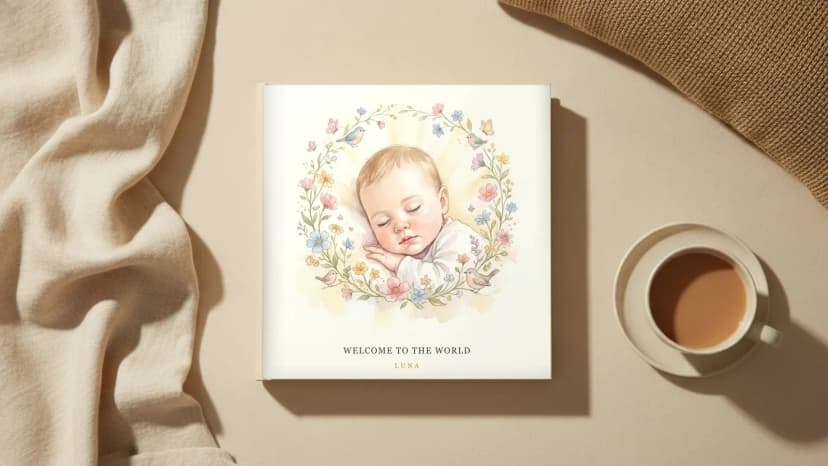
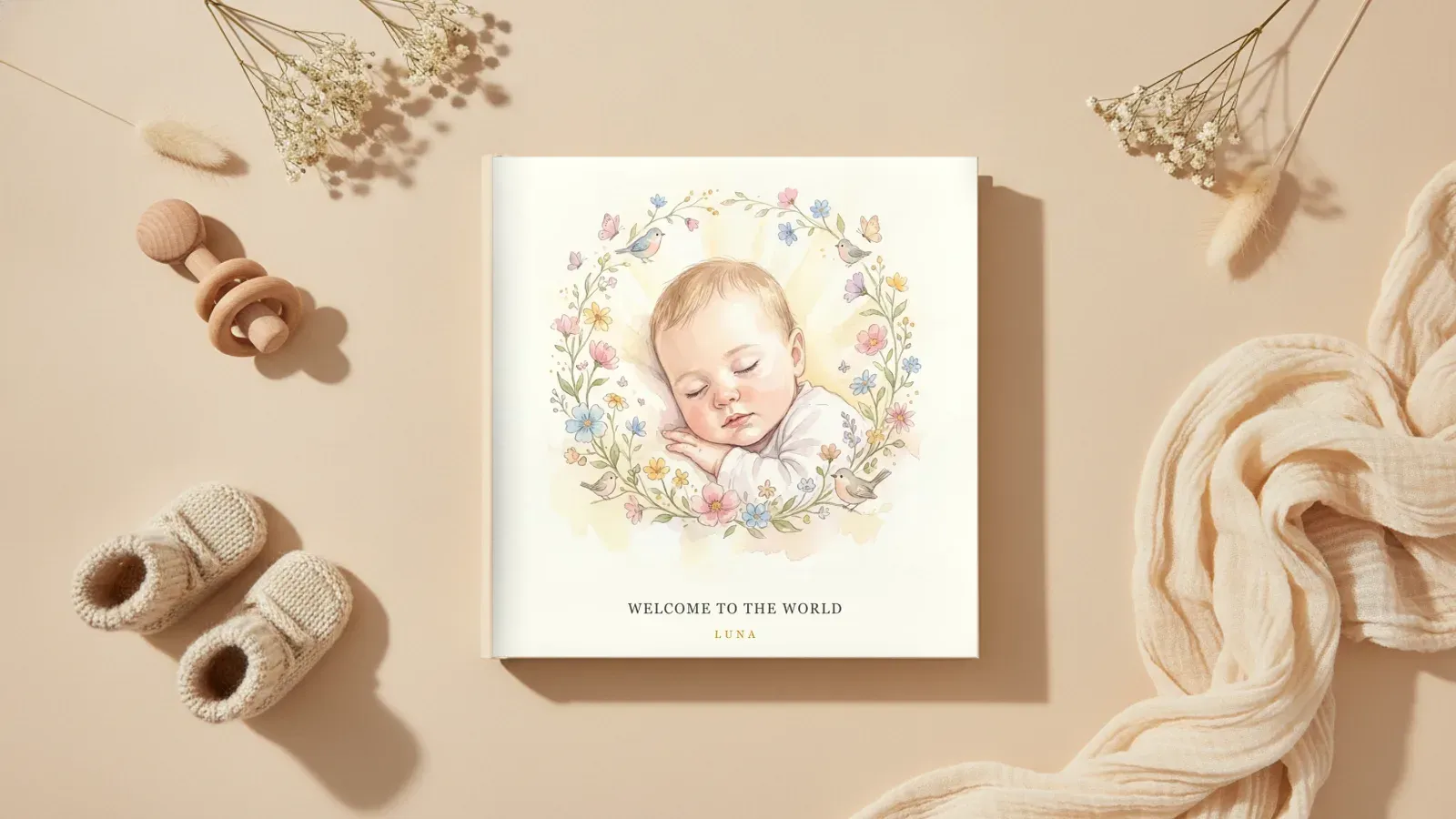
From there, we compose a 50-page illustrated story, 24 double-page spreads, around this baby's arrival. The art is watercolor, soft and warm, designed to look like something a tired parent can hold open with one hand at 3 in the morning. The narrative is gentle. There is no peril, no villain, no dramatic arc. The story is the story of being welcomed: the household that prepared the room, the family who waited, the small first morning when this baby met the world. The baby's name appears on roughly half the pages, never gratuitously, always woven into the rhythm of the sentence.
We print on FSC-certified paper at 170 grams per square meter, a thick warm stock that holds color without making it shout. Softcover or hardcover, your choice. The hardcover is the one most families gift, because it sits on a shelf like a real book, and because a case-bound spine survives a lifetime of little fingers without giving up. The whole object is made in Europe, by a partner that prints for several premium children's book brands. We do not warehouse copies. Yours is printed because you ordered it. That detail matters more than it sounds: it means the book you receive is the only copy of itself anywhere in the world.
The moment of opening
We pay close attention to what families tell us about the first time the book arrives. The patterns are remarkably consistent. The parent who receives it almost always reads it out loud the same evening, often with the baby asleep in their arms. The partner is called over. The phone is set aside, which at one week postpartum is itself a small miracle. One mother wrote to us that her husband, who had not cried in their entire relationship, cried on the dedication page. Another said she put the book on the changing table that first night and read it every morning for a month, the way you might read a quiet prayer.
Grandparents react differently. The grandmother who gives a personalized book often calls a few days later to ask whether the family received it, the way you ask about a letter sent overseas. The grandfather who receives one tends to leaf through it in private, not say much, and then place it carefully on the bookshelf in the living room rather than in the nursery. Both responses, the public reading and the private rereading, point at the same thing: the book is being treated as an object that matters. Not a product. An object that matters.
We collect these notes carefully because they tell us, year after year, what the book actually does in a family's life. It is not displayed and forgotten. It is read aloud at bedtime. It is shown to visiting relatives. It is brought out at the first birthday party, then the third, then the tenth. By the time the child is old enough to read it themselves, the corners of the hardcover are softened from a thousand small hands. That is the gift you wanted to give. Most gifts do not earn that kind of life.
When and how to give it
The most obvious moment is the days after a birth, when a basket of gifts is delivered to the home and the parents are still in the soft, slow opening of their new life. A personalized book given here lands without competition. It is read in the first week and never quite put away.
But the book does not require a delivery date to land well. Many families order it for a baby shower, with the baby's chosen name already locked in, and it sits at the center of the gift table like a small announcement. Others give it at a christening, a baptism, a naming ceremony, where the formal welcome of a child into a community is the explicit point of the day. A book whose entire content is a welcome song fits there better than almost anything else.
The first birthday is another quiet sweet spot. The baby is now a small person with opinions about cake, and the parents have survived a year they are still processing. A book that retells the story of the baby's arrival, given on the anniversary of that arrival, becomes part of the year-one ritual. We have families who now read the book together every June 14th, or every March 3rd, or whatever day belongs to their child. The book becomes a small annual ceremony. That is not a feature we built. It is what families chose to do with it.
If you are giving a personalized book as a gift, the practical part is straightforward. You can compose it yourself in about ten minutes, using the few details you know. Or, if you prefer to let the parents choose the name and the small specifics, you can offer it as a gift card and let them put the book together when they are ready. Both versions arrive well.
A last word
The arrival of a child does not happen often in a family's life. Two, three, sometimes four times across a generation. The gifts given in those weeks are the gifts that get remembered, the ones that become part of the household's story of itself. Most of those gifts are kind, useful, well-meant, and quietly forgettable. A personalized book is the rare exception. It is small enough to wrap, light enough to mail across an ocean, and dense enough in meaning that the family will still be holding it long after, when the baby on the cover has become a tall, grown person turning the pages slowly, the way you do when something matters.
If you are deciding what to bring to a birth, a baby shower, a first birthday, a baptism, we would offer the same quiet recommendation we would give a close friend. Compose a personalized newborn book. Or, if you do not yet know the name or the timing, offer a Spark Stories gift card and let the new family put it together themselves. Either way, you will be giving the kind of gift that stays.